
What Is Creosote Buildup? A Hartford Chimney Technician’s Field Guide to What’s Actually in Your Flue
Creosote buildup is the thick, tar-like residue that forms inside chimney flues when wood smoke cools and condenses on the walls before fully exiting. It accumulates in three distinct stages — flaky soot, sticky tar, and finally glazed, hardened creosote — and becomes increasingly flammable as it progresses. In Hartford, however, what we find clogging many flues isn’t creosote at all: it’s acidic condensate from gas appliances running through oversized, unlined coal-era masonry that’s quietly destroying clay tile from the inside. If you’re noticing weak draft, unusual odors, or haven’t had your flue inspected in over a year, call Legacy Chimney Cleaning Greater Hartford at (877) 257-4956 — we’ll show you exactly what’s up there with a camera inspection.

The Three Stages of Real Creosote — and Why Hartford’s Bigger Problem Hides Behind Them
Most online explainers stop at stage three and call it a day. Here’s what we actually encounter on Hartford roofs, and why the classic creosote story only tells part of the tale.
Stage 1: Sooty Dust
Light, flaky, black — brushes off easily with a standard sweep. This is what you want to find. It means your wood is seasoned, your fire’s hot enough, and your flue’s drafting well. In Hartford’s West End Victorians with their original working fireplaces, we see this when homeowners burn properly dried hardwood and keep the damper open wide enough to maintain temperature.
Stage 2: Tar-Like Crumbs
Sticky, porous, still somewhat brushable but requiring more aggressive tools. This forms when fires smolder, wood is damp, or the flue runs too cool. Hartford’s Connecticut River Valley location — sitting in a natural cold-air drainage basin — makes this stage more common than it should be. That harder freeze-thaw cycling means flue walls stay cooler longer, especially on north-facing exposures.
Stage 3: Glazed, Hardened Shell
Shiny, black, glassy — nearly impossible to remove without rotary chains or chemical treatment. This is the fire hazard everyone warns about. It requires a Chimney Cleaning & Sweep with specialized equipment, not a standard brush job.
But here’s what the generic articles miss: in 17 years on Hartford rooftops, Paul Torres has found true stage-3 glazed creosote primarily in homes with active wood-burning inserts or fireplaces. The far more common scenario in Hartford’s rental stock — those two- and three-family balloon-frames built between 1890 and 1940 — is something entirely different.
The Hartford Flue Problem No One Searches For: Acidic Condensate in Coal-Era Masonry
Creosote is the word everyone searches. It’s not always the word for what’s happening in your flue.
Hartford’s residential neighborhoods — Asylum Hill, Blue Hills, Barry Square, Parkville — are overwhelmingly two- and three-family wood-frame rentals with a single shared masonry chimney stack containing multiple separate flues. These were built for coal. Then converted to oil. Then converted to natural gas. And in that progression, the flues themselves often never got properly relined.
The physics are straightforward and brutal:
- A coal fire ran at roughly 1,500°F — hot enough to keep a massive flue warm and drafting hard
- A modern gas boiler or water heater runs at 300–500°F — barely enough to heat the same oversized flue
- Cold flue walls + moist exhaust gas = condensation
- That condensate combines with sulfur and nitrogen oxides to form sulfuric and nitric acid
- The acid attacks clay tile from the inside, causing spalling, cracking, and eventual flue failure
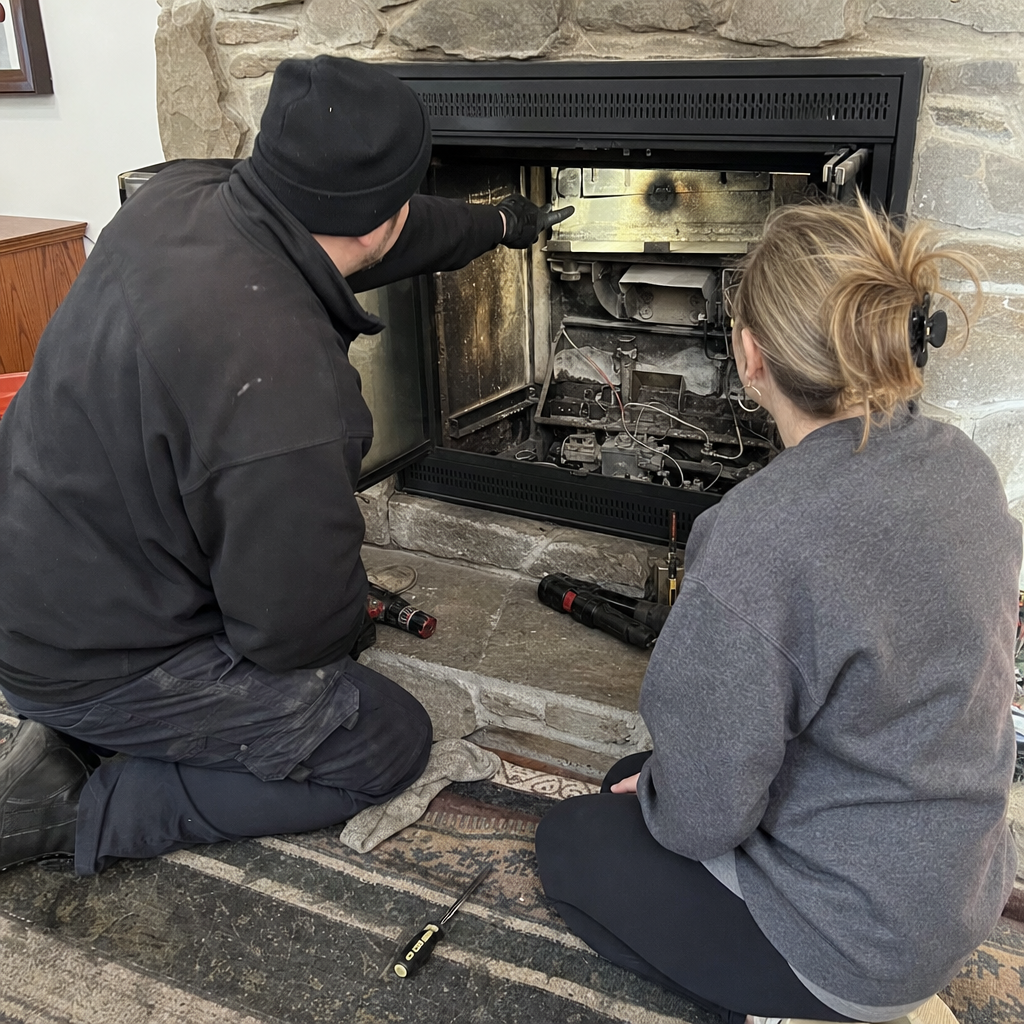
What Paul finds on gas-appliance inspections in Hartford’s pre-1940 stock isn’t black creosote. It’s white efflorescence on tile surfaces. Hairline fractures that widen with each heating season. Partial blockages from tile spall — chunks of deteriorated clay that fall and collect at offsets or bends. None of this triggers a smoke alarm. There’s no visible warning. No fire risk to alert you. Just a flue quietly destroying itself while venting combustion gases into the wall cavity or neighboring unit.
I’ve been on Hartford rooftops for 17 years — I’ll tell you what’s actually up there.
What Creosote Buildup Costs to Remove vs. What Hartford’s Condensate Damage Costs to Fix
Understanding the difference matters for your budget and your safety. Here’s how the two problems compare:
| Condition | What It Looks Like | Typical Hartford Cost Range | Solution |
|---|---|---|---|
| Stage 1–2 Creosote | Flaky or sticky black residue, wood-burning flue | $189–$289 | Standard sweep with rotary or manual brushes |
| Stage 3 Glazed Creosote | Shiny black glaze, hard surface | $289–$450 | Chemical treatment + rotary chain removal |
| Acidic Condensate (Gas Flue) | White powder, tile staining, no visible “soot” | $189–$289 for inspection/cleaning; $1,800–$4,500 if relining needed | Camera inspection, HeatShield resurfacing, or full liner with DuraFlex |
| Tile Spall/Flue Damage | Cracked or missing tile, debris accumulation | $2,200–$5,500 | HeatShield resurfacing or complete liner rebuild with Olympia Chimney components |
These ranges reflect Hartford’s market specifically — costs run slightly higher than coastal Connecticut due to the specialized knowledge required for multi-flue coordination and the structural complexity of century-old masonry. The only way to know which problem you have, and where you fall in these ranges, is to look — and that’s what the camera is for.
How to Tell Which Problem You Have: A Homeowner’s Field Check
We’re not going to send you up on the roof. But there are signs you can spot from the living room that point toward one problem or the other.
If You Burn Wood and Notice These, Suspect Creosote:
- Black, shiny material visible when you open the damper
- Strong, acrid smoke smell that lingers after the fire’s out
- Reduced draft — smoke entering the room on start-up
- Black “soot” flakes falling into the firebox
If You Have Gas Heat and Notice These, Suspect Condensate Damage:
- White or gray powdery residue at the flue connection
- Water stains on the chimney breast or adjacent wall
- Rust on the boiler vent connector or damper
- Musty or “chemical” odor near the appliance — not smoke, but something sharper
- Your landlord had the downstairs unit “cleaned” last year but yours hasn’t been touched in years
That last point is Hartford-specific and critical. In Hartford’s multi-family stock, it’s routine to find one swept flue and a completely deteriorated flue sharing the same chimney cap — each tenant assuming the other flue is “not theirs.” We’ve pulled bird nests from flues that hadn’t been opened in five years while the adjacent unit was swept annually. The masonry stack doesn’t care about your lease boundaries.
Why HeatShield and DuraFlex Matter for Hartford’s Real Problem
Here’s where Legacy’s full-service scope separates from cleaning-only operations. When we find condensate damage rather than creosote, we don’t hand you a referral and a shrug.
HeatShield is a manufacturer-recognized cerfractory resurfacing system — we apply it directly to deteriorated clay tile to restore a smooth, sealed flue surface without a full tear-out. It’s not a Band-Aid; it’s a engineered solution for exactly the kind of tile spall we see in Hartford’s converted coal flues. For more severe cases, we install DuraFlex stainless steel liners — continuous, seamless, properly sized for modern gas appliances — with termination assemblies from Famco or Gelco that handle Hartford’s freeze-thaw cycling without cracking.
Cleaning-only companies can’t offer this. They’ll sweep your flue, tell you it’s “clean,” and miss that your clay tile is dissolving. From your annual sweep to a full liner rebuild, we handle it without bringing in a second contractor.
When Should Hartford Homeowners Schedule a Flue Inspection?
The National Fire Protection Association recommends annual inspection for all chimney systems. In Hartford’s climate and housing stock, we’d push harder on that timeline.
Our freeze-thaw cycle — harder than New Haven or Bridgeport, with roughly 43 inches of annual snow — accelerates mortar-joint erosion and crown deterioration. Every spring inspection, we flag ice-load damage at the crown and flashing line. Combine that with the condensate problem in gas flues, and you’re looking at a system that degrades faster than the national average suggests.
If you fall into any of these categories, don’t wait for symptoms:
- You burn wood more than occasionally through the winter
- You’ve never had a camera inspection of your gas-appliance flue
- You live in a pre-1940 multi-family with shared masonry
- Your landlord “had the chimney done” but you’re not sure which flue was accessed
- You’ve noticed any of the warning signs listed above
Paul Torres personally leads every job — he’s the one on the roof, running the camera, explaining what he’s seeing. Over 1,200 homeowners have trusted us across Greater Hartford, and the 4.7-star average on 1,211 verified reviews reflects a simple formula: show up, tell the truth, fix it right.
FAQs
Standard creosote removal in Hartford typically runs $189–$289 for stage 1–2 buildup, and $289–$450 for stage 3 glazed creosote requiring chemical treatment. If your “creosote” turns out to be condensate damage in a gas flue — common in Hartford’s pre-1940 housing — repair costs range from $189 for inspection and cleaning up to $1,800–$5,500 for HeatShield resurfacing or full liner replacement. Call (877) 257-4956 for a free estimate — we’ll camera-inspect first so you know exactly what you’re dealing with.
Cleaning creosote is always cheaper upfront — $189–$450 versus $1,800–$5,500 for liner work — but that’s the wrong comparison if your real problem is condensate damage. In Hartford’s converted coal-era chimneys, we frequently find homeowners paying for repeated “cleanings” of a flue that doesn’t have a creosote problem; the underlying tile deterioration keeps getting worse. A $289 camera inspection now can save you from a $4,000 emergency liner job later. We don’t sell what you don’t need — but we won’t pretend a broom fixes acid damage.
We offer same-day and next-day scheduling throughout Greater Hartford, including Asylum Hill, Blue Hills, Barry Square, the West End, and surrounding neighborhoods. Emergency response is available for blocked flues, suspected CO issues, or post-chimney fire assessment. For routine inspections, booking within 48 hours is typical during peak season (September–March). Call (877) 257-4956 — we’ll get you on the calendar and tell you what to expect before we arrive.
You can’t tell from the ground — and guessing wrong is expensive. Creosote is black, tarry, and associated with wood burning; condensate damage shows as white efflorescence, tile cracking, or rust staining, and occurs in gas flues through oversized, unlined masonry. The definitive answer requires a camera inspection, which we include in every service call. Paul Torres has identified condensate damage in flues that homeowners — and other companies — assumed just needed a standard sweep. The camera doesn’t lie, and we show you the footage.
What Happens If You Ignore Either Problem
Stage 3 creosote ignites at approximately 451°F — a chimney fire that can reach 2,000°F, crack masonry, and spread to framing. Hartford’s balloon-frame construction, with continuous wall cavities from basement to attic, makes this especially dangerous; fire travels fast in void spaces.
Condensate damage doesn’t burn. It corrodes. Slowly. Silently. Until tile collapses, flue gases vent into walls or neighboring units, and carbon monoxide becomes the threat instead of flame. In Hartford’s triple-deckers, where one stack serves multiple families, a failed flue in one unit can affect others — legally, financially, fatally.
Both problems are preventable. Both are discoverable. The only failure is assuming your flue is fine because you can’t see it.
Ready to Know What’s Actually in Your Flue?
Creosote is the word everyone searches, but it’s not always the word for what’s happening in your flue. Whether you’re dealing with stage-3 buildup from a wood-burning fireplace or the hidden condensate damage that’s standard in Hartford’s converted coal-era masonry, the first step is the same: get eyes on it.
Legacy Chimney Cleaning Greater Hartford offers no-pressure camera inspections throughout the city and surrounding towns. Paul Torres will show you exactly what he’s seeing, explain what it means for your specific system, and quote any needed work upfront — no surprises, no callbacks, no disappearing acts. That’s the Legacy standard: repairs and installations built to last years, not just to pass an inspection.
Call (877) 257-4956 to schedule your inspection or request a free estimate.
Written by Paul Torres, Owner & Lead Technician at Legacy Chimney Cleaning Greater Hartford, serving Hartford, CT.