
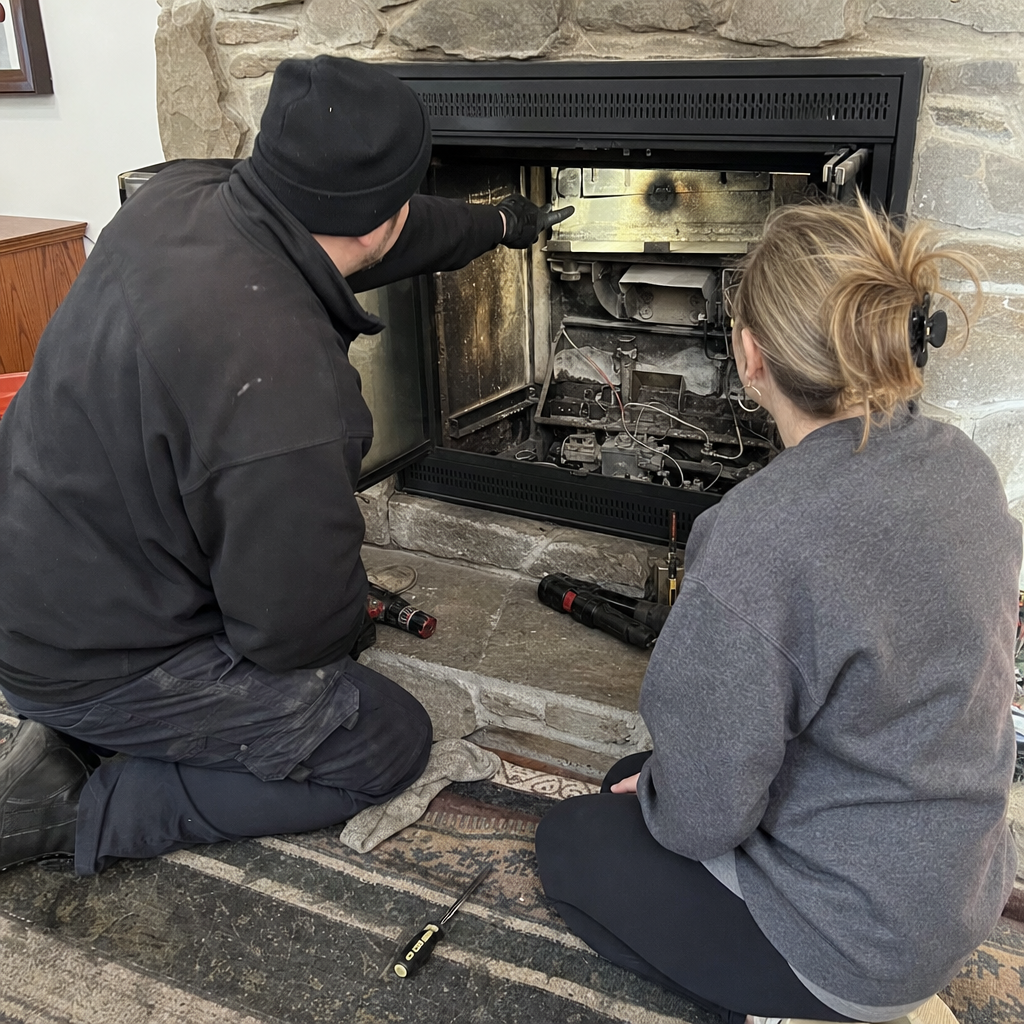
Signs Your Chimney Needs Cleaning in Hartford, CT — What to Watch For (and What You’ll Miss)
Smoke backing into the room, a strong fireplace odor, and black debris collecting in your firebox are the classic signs your chimney needs cleaning. But in Hartford’s housing stock — where gas boilers vent through century-old clay flues that were built for coal — the most dangerous warning signs are invisible: no smoke, no smell, and no way to detect them without a camera inspection. If your last professional chimney evaluation was before 2022, you’re not looking for signs anymore; you’re overdue for a diagnosis. Call Legacy Chimney Cleaning Greater Hartford at (877) 257-4956 for a free estimate on a proper Level 2 inspection.

We’ve spent 17 years on Hartford rooftops, and we’ve learned that the chimneys that keep Paul Torres up at night aren’t the ones with obvious problems. They’re the ones that look fine from the living room. Hartford’s freeze-thaw cycles — harder than coastal Connecticut because of our position in the Connecticut River Valley’s cold-air drainage basin — chew through mortar joints and crown masonry while the flue inside quietly deteriorates. A chimney can appear structurally sound while venting carbon monoxide through hairline cracks in terra cotta tiles that no homeowner can see from below.
Paul Torres personally leads every job at Legacy Chimney Cleaning Greater Hartford, and he’ll tell you straight: the standard “signs you need cleaning” lists floating around online describe problems that are already advanced. In a city where triple-deckers on Blue Hills Avenue and Asylum Hill still run original masonry stacks with multiple flues, the real risks hide in the gaps between what you can observe and what a technician with a camera can reveal.
Visible Signs You’ve Probably Already Heard About — And Why They’re Already Late
Let’s get these out of the way, because every chimney company from New Britain to Manchester will recite them. They’re real, but they’re also the end stage of a problem that started years earlier.
- Smoke rolling back into the room when you light a fire means creosote buildup has narrowed the flue, or a bird nest or collapsed tile is blocking draft. In Hartford’s older homes with multiple flues in one stack, this can also mean a neighboring flue’s failure is disrupting pressure dynamics.
- A strong, acrid fireplace smell — especially in summer humidity — signals creosote deposits absorbing moisture and releasing acidic compounds. That smell is literally the chemical signature of a chimney fire waiting to happen.
- Black, flaky debris in the firebox or on the damper is creosote that’s already detached from the flue wall and fallen. What’s still stuck up there is the bigger concern.
- Visible soot stains on exterior masonry near the chimney top indicate exhaust is escaping through cracked flue tiles and staining the brick — a sign that gases, not just soot, are leaking into the structure.
Here’s the thing Paul Torres has observed across 1,200+ Hartford-area jobs: by the time any of these appear, the chimney has been unsafe for multiple burning seasons. We’ve been on Hartford rooftops for 17 years — we’ll tell you what’s actually up there.
The Invisible Signs That Matter More in Hartford’s Housing Stock
This is where our page diverges from the generic advice you’ll find elsewhere. Hartford’s residential neighborhoods — Asylum Hill, Blue Hills, Barry Square, and the West End — are overwhelmingly served by two- and three-family wood-frame rentals built between 1890 and 1940. Their chimneys were designed for coal, converted to oil, then converted again to natural gas. Those successive conversions frequently left flues without proper relining, or with deteriorated 4-inch terra cotta tiles that fracture under modern appliance exhaust conditions.
The result? A gas boiler or water heater can vent carbon monoxide through cracked tiles into the chimney chase, the attic, or — in multi-family buildings — into adjacent units. And because CO is odorless, colorless, and produces no smoke, there’s no homeowner-detectable warning.
Paul Torres flags these specific invisible risk indicators during Level 2 camera inspections:
- A faint exhaust smell in the boiler room or utility area that persists even after the HVAC service company confirms the appliance itself is clean and properly tuned. If the unit is fine, the problem is above it — in the flue. We’ve traced this exact scenario to cracked clay tiles in stacks on Blue Hills Avenue more than once.
- One flue in a multi-flue stack “working fine” while the other hasn’t been inspected in years. In Hartford’s triple-deckers, it’s routine to find a landlord had the first-floor fireplace swept last season while the upstairs tenant’s gas boiler flue — sharing the same masonry stack, the same cap, the same crown — has gone untouched for five or more years. A properly functioning flue beside a failing one can actually mask the problem by maintaining adequate draft for the whole stack. One flue working doesn’t mean the stack is safe.
- Moisture or rust stains on the boiler jacket or water heater top where the vent connector enters the chimney. This indicates condensation — and condensation in a gas flue means the liner is compromised, the sizing is wrong for the appliance, or both. Hartford’s cold winters accelerate this: hot exhaust hitting a cold, unlined masonry flue condenses acidic moisture that destroys metal and masonry alike.
- White efflorescence or spalling brick on the exterior chimney face, especially after Hartford’s hard freeze-thaw cycles. This isn’t just cosmetic water damage — it’s evidence that exhaust gases and moisture are migrating through the masonry because the flue liner no longer contains them.
These conditions don’t announce themselves with smoke or odor. They announce themselves with a CO detector going off — or worse, with symptoms that get attributed to something else entirely.
Why Hartford’s Coal-Era Clay Tiles Specifically Need Camera Inspection, Not Just Brush-and-Go Cleaning
A Level 1 visual inspection — what many companies sell as a “cleaning” — examines only readily accessible portions of the chimney exterior and interior. The technician looks up the flue from the fireplace or down from the roof, but doesn’t see what’s happening mid-flue, behind offsets, or inside the smoke chamber.
A Level 2 inspection, which Paul Torres recommends for every Hartford chimney that hasn’t had camera documentation in the past three years, uses a high-resolution video camera on a flexible rod to record the entire flue interior. In Hartford’s clay-tile flues, we’re specifically looking for:
- Longitudinal cracks in tile joints — common where freeze-thaw cycling has shifted the masonry stack
- Tile displacement or missing tiles, often at turns or offsets where original coal-era construction didn’t anticipate modern appliance venting
- Gaps between tile sections where mortar has eroded, allowing gas migration into the chimney wall
- Glazed or puffy creosote deposits that indicate prior chimney fires — surprisingly common in wood-burning units that homeowners assumed “just smoked a little”
Without this documentation, you’re guessing. And in a 1920s Hartford rental with three units sharing one stack, guessing isn’t a maintenance strategy — it’s a liability exposure.
What a Proper Hartford Chimney Evaluation Actually Involves
At Legacy Chimney Cleaning Greater Hartford, our Chimney Cleaning & Sweep service isn’t a quick brush-and-vacuum. Paul Torres personally leads every job, and our process reflects what he’s learned from 17 years of hands-on work in this specific housing stock.
Here’s how we structure a typical evaluation and cleaning for Hartford properties:
| Service Component | What’s Included | Typical Range (Hartford Market) |
|---|---|---|
| Level 1 Visual Inspection & Basic Sweep | Exterior masonry check, firebox and damper inspection, flue brushing, debris removal | $175 – $250 |
| Level 2 Camera Inspection | Full video scan of flue interior, smoke chamber evaluation, written report with footage | $275 – $395 |
| Level 2 with Sweep | Combined camera inspection and mechanical cleaning — our standard recommendation for Hartford homes without recent documentation | $325 – $450 |
| Multi-Flue Stack (per additional flue) | Separate inspection and documentation for each flue in shared masonry — critical for Hartford rentals | $125 – $195 per additional flue |
| HeatShield Cerfractory Flue Resurfacing | Application of UL-listed cerfractory sealant to restore cracked clay tile flues without full relining — a cost-effective solution for select Hartford applications | $1,800 – $3,200 |
| Stainless Steel Liner Installation (DuraFlex) | Full relining with professional-grade DuraFlex or Olympia Chimney materials, sized to appliance | $2,400 – $4,500 |
These ranges reflect Hartford’s market specifically — not Boston, not New Haven. Labor costs, access challenges with our older housing stock, and the frequency of multi-flue coordination all factor in. We don’t quote over the phone for liner work without seeing the job; anyone who does is guessing, and guessing isn’t how you build a legacy.
We use professional-grade materials — DuraFlex, HeatShield, Gelco — because Hartford’s freeze-thaw punishment destroys inferior products. A liner or crown repair that fails in three years because someone used box-store materials isn’t a savings; it’s a do-over, and we don’t do do-overs.
How Hartford’s Climate and Geography Accelerate Chimney Deterioration
Hartford sits in the Connecticut River Valley, a natural cold-air drainage basin that gives us harder freeze-thaw cycling than coastal cities. Averaging roughly 43 inches of snow annually, our chimneys face repeated ice-load and freeze-thaw stress at the crown and flashing line — conditions Paul Torres and our team flag at virtually every spring inspection.
This matters for the “signs your chimney needs cleaning” question because the deterioration isn’t uniform. A flue that was sound in October can develop new cracks by April after a Hartford winter. The thermal expansion differential between the hot flue gases and the frozen exterior masonry creates stress that coal-era clay tiles simply weren’t engineered to handle.
In the West End’s large Victorians — multi-fireplace homes with four or five separate flues in one oversized stack — we routinely find that homeowners have cleaned the “main” fireplace flue for years while the others, some serving long-disused second-floor fireplaces, have never been inspected. These dormant flues accumulate moisture, debris, and animal nesting; when they’re eventually opened or when stack pressure changes affect the whole system, they become the problem no one anticipated.
When “No Signs” Is Actually the Worst Sign of All
Paul Torres has a saying he shares with Hartford landlords who call after a tenant’s CO detector triggered: “The chimney that scares me isn’t the one that’s smoking. It’s the one that’s been ‘fine’ for fifteen years.”
If you’re reading this article because you want to know the signs your chimney needs cleaning, and your last professional evaluation was before 2022, you’re past the sign-reading stage. Here’s what Paul Torres recommends instead:
- Schedule a Level 2 camera inspection if your flue serves any gas appliance and has never been video-documented. This is non-negotiable for Hartford’s unlined or clay-tile flues.
- Inspect all flues in a shared stack, not just the one you use most. The swept flue and the sooted flue share the same cap, the same crown, and often the same deterioration pattern.
- Document everything. A written report with video footage protects landlords, satisfies insurance requirements, and gives you baseline data for comparison at the next inspection.
- Address liner integrity before cleaning frequency. A cracked liner makes cleaning frequency irrelevant — the flue is failing structurally, not just dirty.
From your annual sweep to a full liner rebuild, Legacy Chimney Cleaning Greater Hartford handles the complete scope. You don’t need a second company for the repair after we’ve found the problem. Paul Torres personally leads every job, and our 1,211 verified reviews at 4.7 stars reflect what happens when the owner is also the technician who shows up, climbs the ladder, and explains what he found.
FAQs
A Level 1 visual inspection and basic sweep in Hartford typically runs $175–$250, while a Level 2 camera inspection with full documentation ranges from $275–$395. For homes with gas appliances venting through older masonry — which describes most of Hartford’s housing stock — we recommend the Level 2 to catch cracked clay tiles and liner gaps that a visual inspection will miss. Call (877) 257-4956 for an exact quote; estimates are free.
Yes — and in Hartford, this is the scenario we worry about most. Gas appliance flues with cracked terra cotta tiles can vent carbon monoxide into wall cavities, attics, or adjacent rental units with zero visible warning. No smoke, no odor, no soot on the floor. The only reliable detection is a Level 2 camera inspection of the flue interior. If your boiler room smells faintly of exhaust but the HVAC company says the unit itself is clean, the problem is almost certainly in the flue above it.
For wood-burning fireplaces, the National Fire Protection Association recommends annual inspection and cleaning as needed based on creosote accumulation. For gas appliance flues in Hartford’s older housing — especially unlined or clay-tile flues in pre-1940 masonry — we recommend a Level 2 camera inspection every 2–3 years regardless of apparent condition, because freeze-thaw deterioration progresses invisibly. If you can’t recall your last inspection date, schedule one now; you’re not maintaining a schedule, you’re catching up.
For localized tile cracking with otherwise sound masonry, HeatShield cerfractory resurfacing ($1,800–$3,200) often restores flue integrity without full replacement. For widespread tile failure, offset flues, or sizing mismatches with modern appliances, a stainless steel liner (DuraFlex or Olympia Chimney, $2,400–$4,500) is the longer-term solution. Paul Torres evaluates each Hartford chimney individually — the “cheaper” option that fails in five years isn’t cheaper. Call (877) 257-4956 for a no-pressure assessment and honest recommendation.
What to Do If You Recognize Any of These Signs
If you’ve noticed smoke backup, persistent odors, or any of the invisible indicators we’ve described — or if you simply can’t remember your last professional evaluation — the next step is documentation, not guesswork. Hartford’s housing stock demands a technician who understands coal-era masonry, multi-flue dynamics, and the specific failure patterns our freeze-thaw climate produces.
Paul Torres grew up in Hartford’s Parkville neighborhood, where triple-deckers with working fireplaces were as common as corner bodegas, and he spent enough winters watching his father wrestle with a smoky chimney to know the problem needed a real solution. He trained in building trades and HVAC fundamentals at Asnuntuck Community College before spending years learning chimney work from the ground up — brush in hand, on actual roofs, in actual Hartford winters. For the past 17 years he’s been the one showing up to your house, not dispatching someone else to do it.
If you’d rather have it looked at, Legacy Chimney Cleaning Greater Hartford offers a no-pressure assessment in Hartford — call (877) 257-4956 for a free estimate. We’ll tell you what’s actually up there, what it needs, and what it doesn’t.
Written by Paul Torres, Owner & Lead Technician at Legacy Chimney Cleaning Greater Hartford, serving Hartford, CT.